Fan Lu

Postdoctoral Researcher · Tongji University

I am a postdoctoral researcher in the School of Computer Science at Tongji University, jointly advised by Prof. Changjun Jiang and Prof. Guang Chen. I also serve as a Technical Advisor and Algorithm Expert in World Models at Hello Robotaxi. I received my bachelor’s degree in Automotive Engineering in 2020 and my Ph.D. in 2024, both from the School of Automotive Studies at Tongji University.

Research focus. My research aims to build a unified world model for scene synthesis and robot action. I am interested in learning representations that connect 3D scene generation, physical dynamics, and action, enabling robots to understand their surroundings, anticipate the consequences of their actions, and plan and interact with the physical world.

Portrait of Fan Lu

News

  • Urban Architect was accepted by IEEE TPAMI.
  • I have been invited to serve as an Area Chair for ICML 2027.
  • We released HelloWorld, a generative driving world model for controllable scene synthesis and closed-loop simulation.
  • I have been invited to serve as an Area Chair for ICLR 2027.
  • Two papers were accepted to ICRA 2026: Efficient TC4DGS and MGS-Track.
  • Three papers were accepted to ICLR 2026: SSA, CoNavBench, and GOOD.
  • I was selected for the Postdoctoral Innovative Talent Support Program.
  • Three papers were accepted to NeurIPS 2025: CHPO, OOD-Barrier, and MUP.
  • DiffAlign was accepted by IEEE TCSVT.
  • DCR was accepted by IEEE T-ASE.
  • I received my Ph.D. and started my postdoctoral research at Tongji University.
Show older newsShow less
  • We release UrbanArchitect, a novel pipeline for large-scale 3D urban scene generation.
  • One paper on dynamic LiDAR novel view synthesis got accepted to CVPR 2024.
  • One paper on Neural rendering got accepted by ICCV 2023.
  • Our extension of HRegNet got accepted by IEEE T-PAMI.
  • One paper got accepted by IEEE T-PAMI.
  • Two papers got accepted by IEEE T-VT and IEEE T-ITS.
  • One paper got accepted by ICCV 2021.
  • One paper got accepted by AAAI 2021.
  • One paper got accepted by NeurIPS 2020.

Selected Publications

Google Scholar

* Equal contribution · † Corresponding author

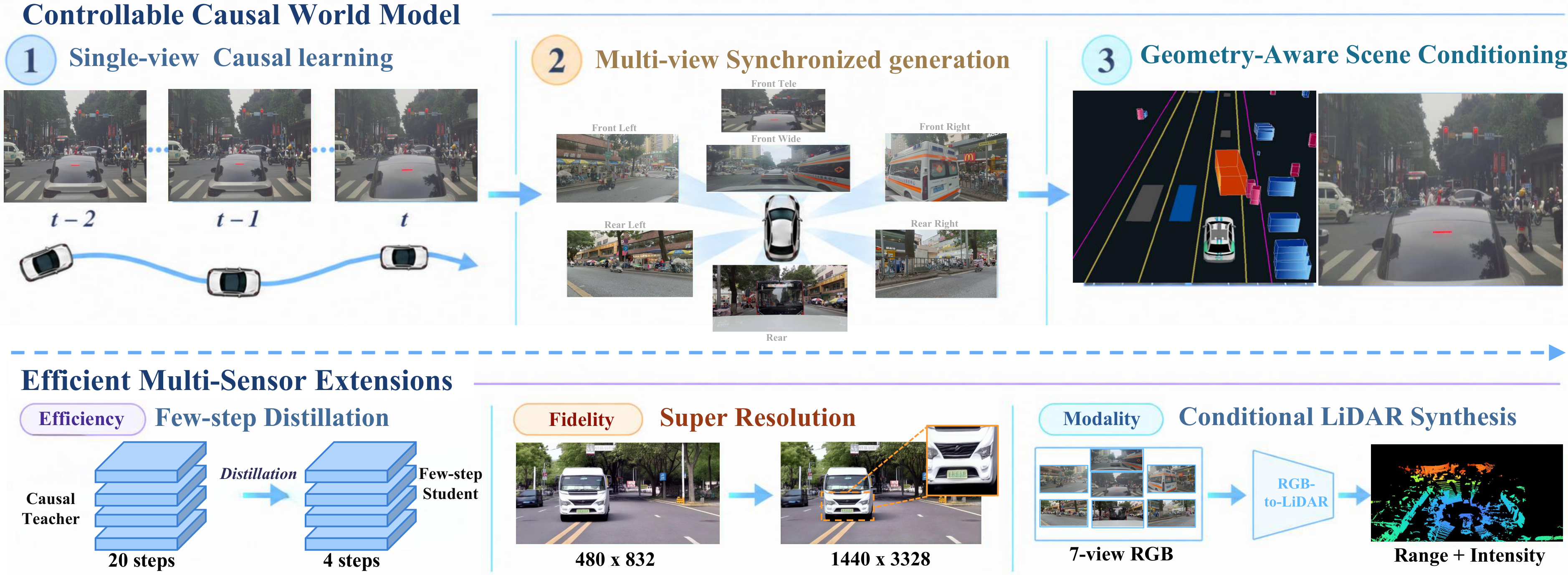
HelloWorld overview: controllable multi-view driving scene generation and multi-sensor synthesis

HelloWorld: Towards Practical Applications of Generative Driving World Models

HelloWorld Team (Fan Lu: first author)

Technical Report, 2026

A unified driving world model combining controllable multi-view video generation and LiDAR synthesis for scene editing, training data generation, and closed-loop simulation.
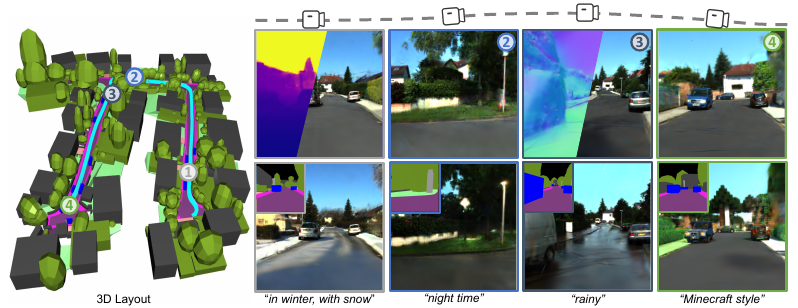
Overview of Urban Architect: Steerable 3D Driving Scene Generation with Layout Prior

Urban Architect: Steerable 3D Driving Scene Generation with Layout Prior

Fan Lu*, Kwan-Yee Lin*, Yan Xu, Hongsheng Li, Guang Chen†, Changjun Jiang

IEEE Transactions on Pattern Analysis and Machine Intelligence (TPAMI), 2026

Steerable, large-scale 3D driving scene generation from text and compositional layouts, with control over scene geometry, appearance, and editing.

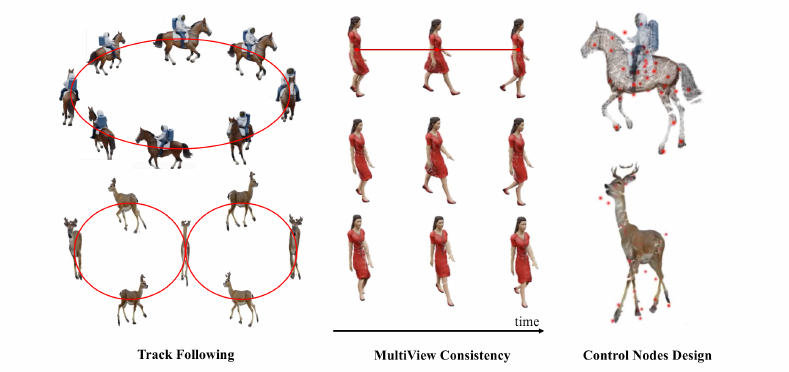
Overview of Efficient Trajectory-Conditioned Text-to-4D Gaussian Splatting

Efficient Trajectory-Conditioned Text-to-4D Gaussian Splatting

Lin Shao, Fan Lu†, Haiyun Wei, Sanqing Qu, Alois Knoll, Guang Chen†

IEEE International Conference on Robotics and Automation (ICRA), 2026

Efficient generation of dynamic 4D assets along specified trajectories, combining Gaussian splatting with control-node deformation to preserve motion quality.

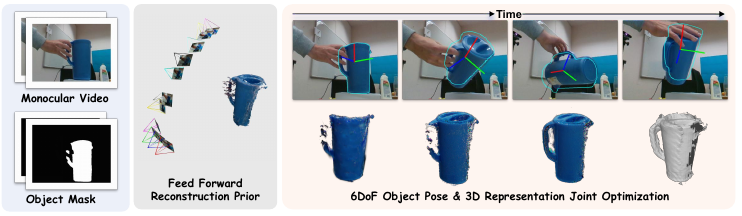
Overview of MGS-Track: Monocular 6DoF Pose Tracking via Masked 3D Prior and Online Gaussian Splatting

MGS-Track: Monocular 6DoF Pose Tracking via Masked 3D Prior and Online Gaussian Splatting

Zhiyuan Chen, Fan Lu†, Guo Yu, Sanqing Qu, Ya Wu, Yuan Huang, Alois Knoll, Guang Chen†

IEEE International Conference on Robotics and Automation (ICRA), 2026

Joint 6DoF object tracking and reconstruction from monocular video, using mask-aware geometric priors and online Gaussian splatting for robotic manipulation scenarios.

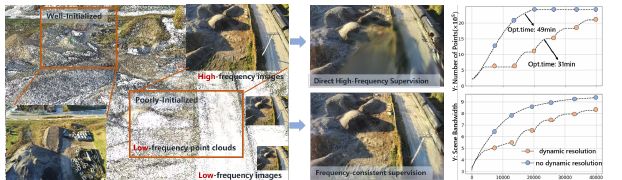
Overview of Signal Structure-Aware Gaussian Splatting for Large-Scale Scene Reconstruction

Signal Structure-Aware Gaussian Splatting for Large-Scale Scene Reconstruction

Weiyi Xue, Fan Lu†, Chi Zhang, Tianhang Wang, Sanqing Qu, Zehan Zheng, Boyuan Zheng, Junqiao Zhao, Guang Chen†

International Conference on Learning Representations (ICLR), 2026

Frequency-aware scheduling aligns image supervision with Gaussian densification, improving reconstruction quality and efficiency in large-scale scenes.

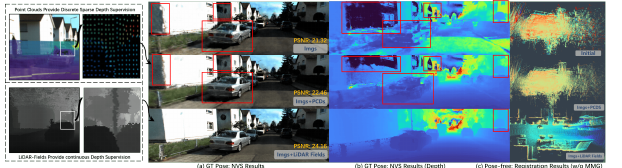
Overview of Multimodal LiDAR-Camera Novel View Synthesis with Unified Pose-free Neural Fields

Multimodal LiDAR-Camera Novel View Synthesis with Unified Pose-free Neural Fields

Weiyi Xue, Fan Lu†, Yunwei Zhu, Zehan Zheng, Haiyun Wei, Sanqing Qu, Jiangtong Li, Ya Wu, Guang Chen†

Advances in Neural Information Processing Systems (NeurIPS), 2025

Unified LiDAR-camera neural fields jointly optimize sensor poses and scene representations, enabling multimodal novel view synthesis without accurate input poses.

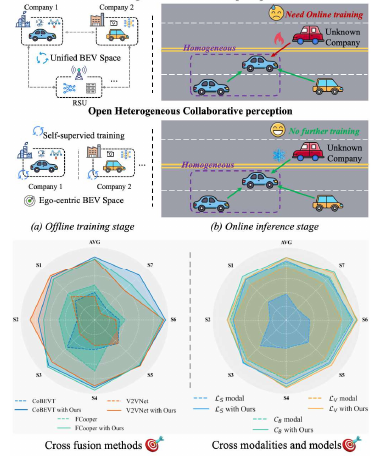
Overview of An Online-Training-Free Adaptor for Open Heterogeneous Collaborative Perception via Diffusion Model

An Online-Training-Free Adaptor for Open Heterogeneous Collaborative Perception via Diffusion Model

Tianhang Wang*, Fan Lu*, Sanqing Qu†, Bin Li, Ya Wu, Hu Cao, Alois Knoll, Guang Chen†

IEEE Transactions on Circuits and Systems for Video Technology (TCSVT) · Accepted 2025; Vol. 36, 2026

DiffAlign uses a pretrained diffusion model to align features across heterogeneous agents, enabling collaborative perception without online training or access to model internals.

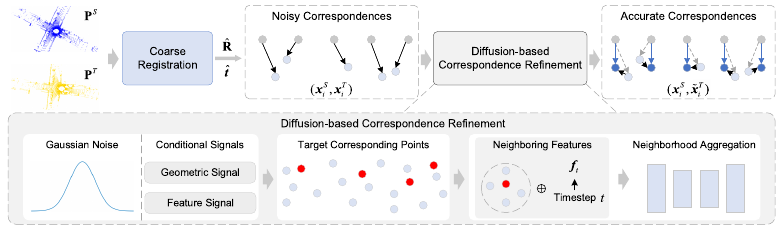
Overview of Post-Refining LiDAR Point Cloud Registration via Diffusion-Based Correspondence Refinement

Post-Refining LiDAR Point Cloud Registration via Diffusion-Based Correspondence Refinement

Fan Lu, Tianhang Wang, Guo Yu, Bin Li†, Qiao Lin, Alois Knoll, Zhijun Li, Guang Chen

IEEE Transactions on Automation Science and Engineering (T-ASE) · Accepted 2025; Vol. 23, 2026

DCR refines noisy point correspondences with a conditional diffusion model, improving the accuracy of both learned and traditional LiDAR registration methods.

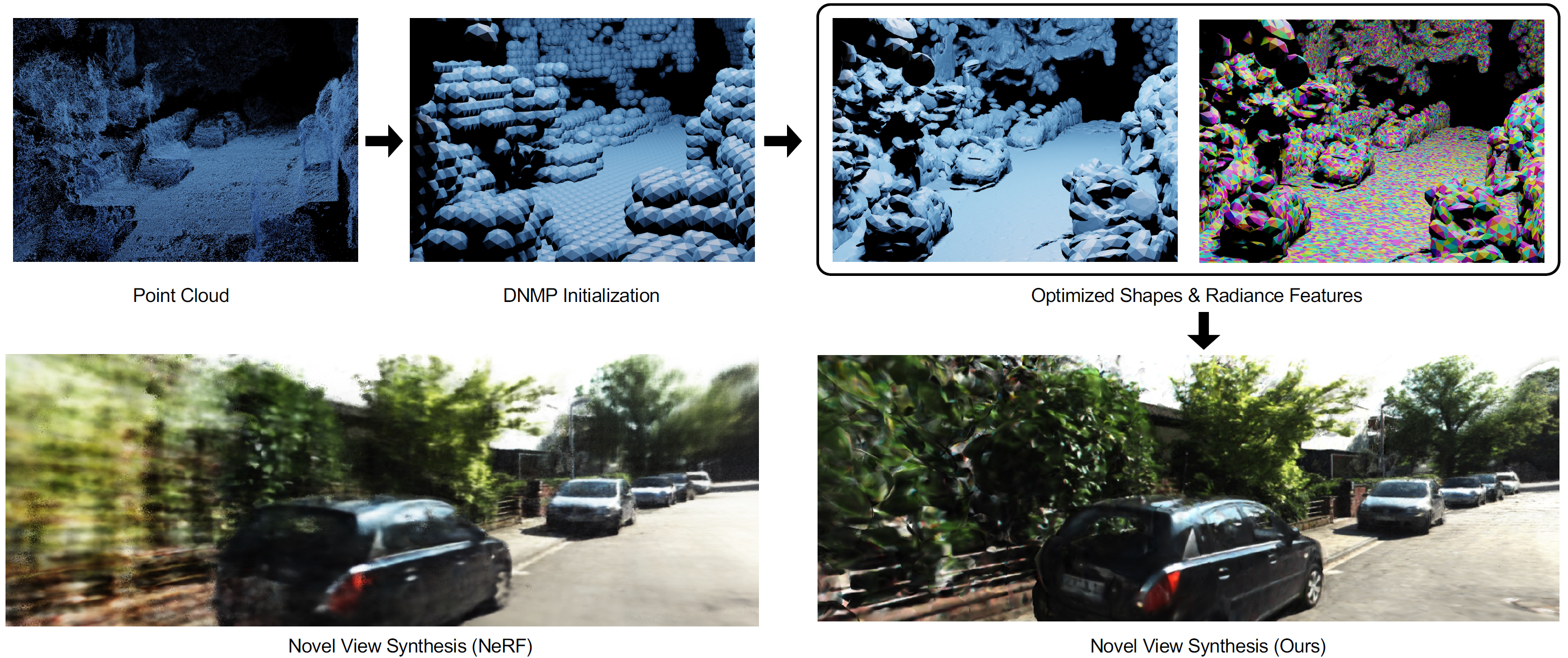
Overview of Urban Radiance Field Representation with Deformable Neural Mesh Primitives

Urban Radiance Field Representation with Deformable Neural Mesh Primitives

Fan Lu*, Yan Xu*, Guang Chen†, Hongsheng Li, Kwan-Yee Lin†, Changjun Jiang

International Conference on Computer Vision (ICCV), 2023

This paper proposes a novel neural rendering framework for urban scenes. We represent the urban scene as a set of deformable neural mesh primitives (DNMPs), which are able to capture the complex geometry and appearance of urban scenes.

Overview of HRegNet: A Hierarchical Network for Efficient and Accurate Outdoor LiDAR Point Cloud Registration

HRegNet: A Hierarchical Network for Efficient and Accurate Outdoor LiDAR Point Cloud Registration

Fan Lu, Guang Chen†, Yinlong Liu, Lijun Zhang, Sanqing Qu, Shu Liu, Rongqi Gu, Changjun Jiang

IEEE Transactions on Pattern Analysis and Machine Intelligence (T-PAMI), 2023

Extended journal version of HRegNet

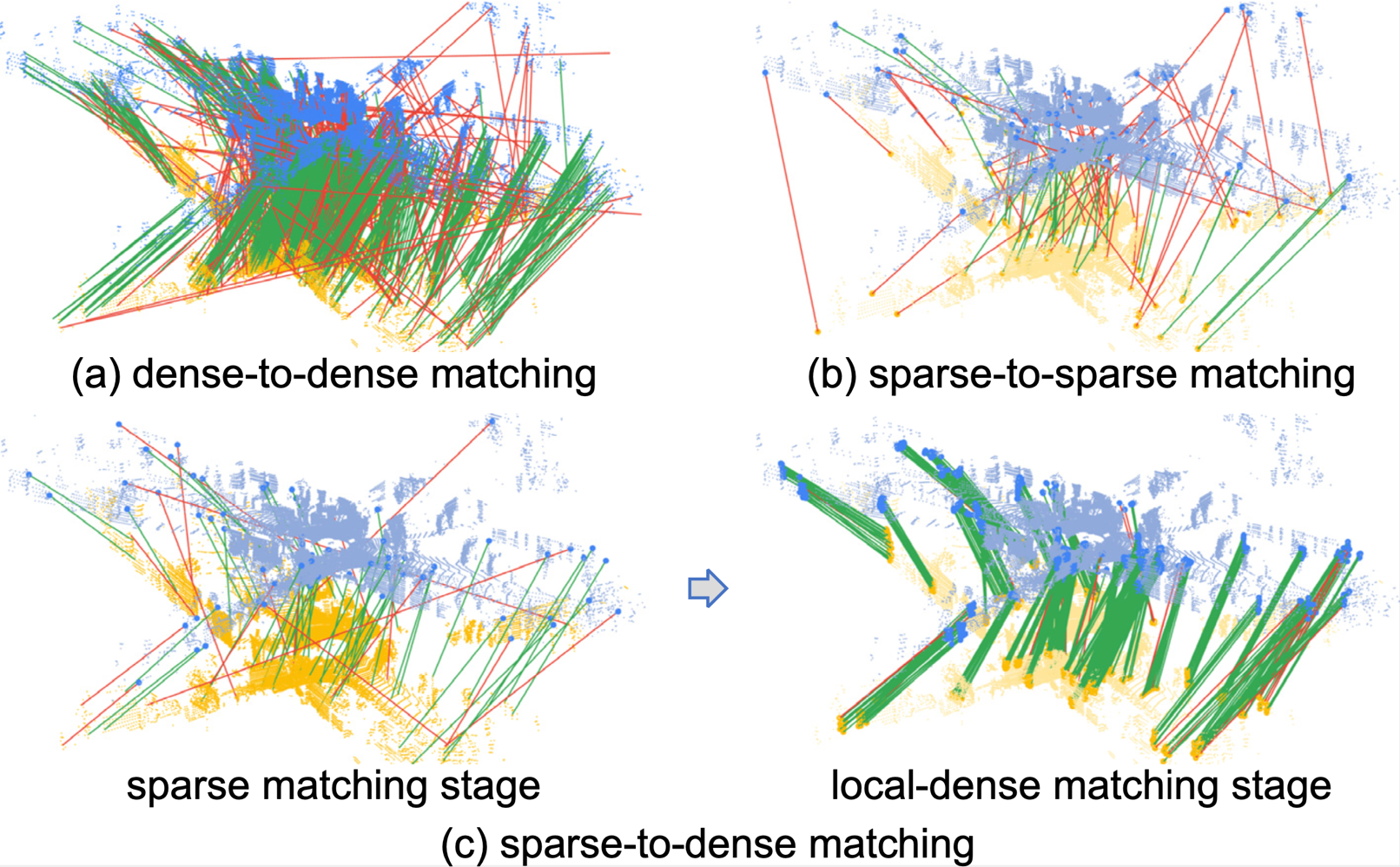
Overview of Sparse-to-Dense Matching Network for Large-scale LiDAR Point Cloud Registration

Sparse-to-Dense Matching Network for Large-scale LiDAR Point Cloud Registration

Fan Lu, Guang Chen†, Yinlong Liu, Yibing Zhan, Zhijun Li, Dacheng Tao, Changjun Jiang

IEEE Transactions on Pattern Analysis and Machine Intelligence (T-PAMI), 2023

This paper proposes a Sparse-to-Dense Matching Network (SDMNet), which performs registration in two stages: sparse matching stage and local-dense matching stage. We design a novel neighborhood matching module to incorporate local neighborhood consensus and the local-dense matching stage is followed for fine-grained performance.

Overview of HRegNet: A Hierarchical Network for Large-scale Outdoor LiDAR Point Cloud Registration

HRegNet: A Hierarchical Network for Large-scale Outdoor LiDAR Point Cloud Registration

Fan Lu, Guang Chen†, Yinlong Liu, Lijun Zhang, Sanqing Qu, Shu Liu, Rongqi Gu

International Conference on Computer Vision (ICCV), 2021

This paper proposes a hierarchical network named HRegNet, which leverages rich features in deeper layer and precise location information of keypoints in shallower layers for robust and accurate LiDAR point cloud registration. Bilateral consensus and neighborhood consensus are utilized to improve the robustness of the keypoints matching.

Overview of PointINet: Point Cloud Frame Interpolation Network

PointINet: Point Cloud Frame Interpolation Network

Fan Lu, Guang Chen†, Sanqing Qu, Zhijun Li, Yinlong Liu, Alois Knoll

Thirty-Fifth AAAI Conference on Artificial Intelligence (AAAI), 2021

We propose a novel framework, namely Point Cloud Frame Interpolation Network (PointINet). Based on the proposed method, the low frame rate point cloud streams can be upsampled to higher frame rates.

Overview of MoNet: Motion-based Point Cloud Prediction Network

MoNet: Motion-based Point Cloud Prediction Network

Fan Lu, Guang Chen†, Yinlong Liu, Zhijun Li, Sanqing Qu, Tianpei Zou

IEEE Transactions on Intelligent Transportation Systems (T-ITS), 2021

Overview of RSKDD-Net: Random Sample-based Keypoint Detector and Descriptor

RSKDD-Net: Random Sample-based Keypoint Detector and Descriptor

Fan Lu, Guang Chen†, Yinlong Liu, Zhongnan Qu, Alois Knoll

Advances in Neural Information Processing Systems (NeurIPS), 2020

This paper proposes Random Sample-based Keypoint Detector and Descriptor Network (RSKDD-Net) for large scale point cloud registration. The key idea is using random sampling to efficiently select candidate points and using a learning-based method to jointly generate keypoints and descriptors.

Education

  • 2020–2024

    Tongji University

    Ph.D. · School of Automotive Studies

  • 2015–2020

    Tongji University

    Bachelor’s Degree in Automotive Engineering

Experience

  • Present

    Hello Robotaxi

    Technical Advisor & Algorithm Expert · World Models

  • 2024–Present

    Tongji University

    Postdoctoral Researcher · School of Computer Science

    Joint advisors: Changjun Jiang and Guang Chen

  • 2023.07–2024.06

    Shanghai AI Laboratory

    Research Intern

  • 2022.06–2023.06

    Sensetime Research

    Research Intern

  • 2021.06–2021.09

    JD Explore Academy

    Research Intern

Academic Services

  • Area ChairICLR 2027, ICML 2027
  • Conference reviewerCVPR, ICCV, ECCV, NeurIPS, ICLR, ICML, AAAI, 3DV, ICRA, IROS, WACV, etc.
  • Journal reviewerIEEE T-PAMI, IEEE T-ASE, IEEE T-IM, IEEE T-MM, IEEE/CAA JCA, ACM TOMM, Neurocomputing, etc.

Honors & Awards

  • Outstanding Doctoral Dissertation Award, Tongji University
  • World Artificial Intelligence Conference (WAIC) Youth Outstanding Paper Award
  • Shanghai Outstanding Graduate
  • Second Prize of National Post-Graduate Mathematical Contest in Modeling

Contact

lufan11223@gmail.com
Back to top ↑